|
|
Blooms: March - July Habit: herb Duration: annual Origin: Native
|
Distribution: Alaska south to California and Colorado, east to Ontario and Michigan; widespread throughout Washington. Habitat: Lowlands to alpine meadows in vernally (springtime) moist areas.
|
|
Species Description:
General: Herbaceous annual with single or branched stems growing to height of 5-40 cm. Plants often found growing in masses. Leaves: Opposite, mostly glabrous and entire-margined; leaves sometimes whorled near top of plant; up to 5 cm. long and about 1 cm. wide. Stems and flower pedicels often have short hairs that are sometimes glandular. Flowers: 4-7 mm. long, bilabiate (two-lipped) with blue lower lip and white to whitish pink upper lip; lower half of corolla tube fused and abruptly bent near base forming a small sac on upper side of corolla base. Fruit: Ellipse-shaped capsule up to 5 mm. long and typically shorter than the sepals.
Distinguishing Characteristics: Base of corolla is bent at obligue angle. In C. grandiflora the corolla is bent at right angle.
Notes: May hybridize with C. grandiflora.
|
Full Name with Authors:
Collinsia parviflora Lindl.
Synonyms:
(none)
Treated in Flora of the PNW as:
Collinsia parviflora |
Additional Resources:
WTU Herbarium Specimens: View list of Collinsia parviflora specimens in the WTU Herbarium database.
Washington Flora Checklist: Collinsia parviflora treatment.
Oregon Flora Project Atlas: Collinsia parviflora atlas page.
E-Flora BC: Collinsia parviflora atlas page.
CalPhotos: Collinsia parviflora images.
USDA Plants Database: Collinsia parviflora. |
|

|
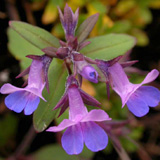
Note the opposite leaves in the middle of the plant, and whorled ones at the top. Flowers are clearly bilabiate (two-lipped) with blue lower lip. Hairiness along the stems is also evident in the photo. Image © 2004, Ben Legler |

|

|
Populations of C. parviflora often occur as masses of individual plants. Image © 2004, Ben Legler |

|
|